


Table of Contents
How Traumatic Brain Injuries Affect Mobility and Flexibility—and How Chiropractic Care Restores Them

A car crash. A disastrous fall. A sports hit. One second can change everything. Head injuries and traumatic brain injuries (TBIs) don’t just hurt your skull—they can make your legs feel heavy, your arms stiff, and your balance wobble like you’re on a boat. This guide explains exactly why movement becomes challenging after a TBI, how minor issues can escalate into significant problems, and how gentle chiropractic care combined with targeted exercises can help you regain your ability to walk, reach, and stand tall again.
The Day Walking Feels Like Climbing a Mountain
After a head injury, many people notice their first steps are shaky. The brain is the body’s central control system. When it gets rattled, the signals to your muscles get fuzzy. You might drag one foot, sway side to side, or freeze mid-step.
Doctors call this “impaired coordination and balance disturbances” (Headway, n.d.). In plain words: your brain forgets how to talk to your legs. Even mild TBIs leave tiny changes in how you walk—changes big enough to trip you on a curb or tire you out after one lap around the grocery store (Brain Injury Association of America, n.d.-b).
Muscle Fatigue Shows Up Fast
Fatigue is the silent thief. One minute you’re fine; the next, your thighs burn and your knees buckle. TBI damages the energy factories inside muscle cells, so legs give out sooner than they should (Model Systems Knowledge Translation Center, n.d.). Add pain or a headache, and every step feels twice as hard.
From Small Wobble to Full Freeze
Problems start small:
- A slight limp
- Needing a handrail
- Arms that don’t swing
Left alone, these grow. Muscles that don’t move shorten. Joints stiffen. Doctors see everything from “minor difficulties with walking to complete paralysis” (Brain Injury Canada, n.d.).
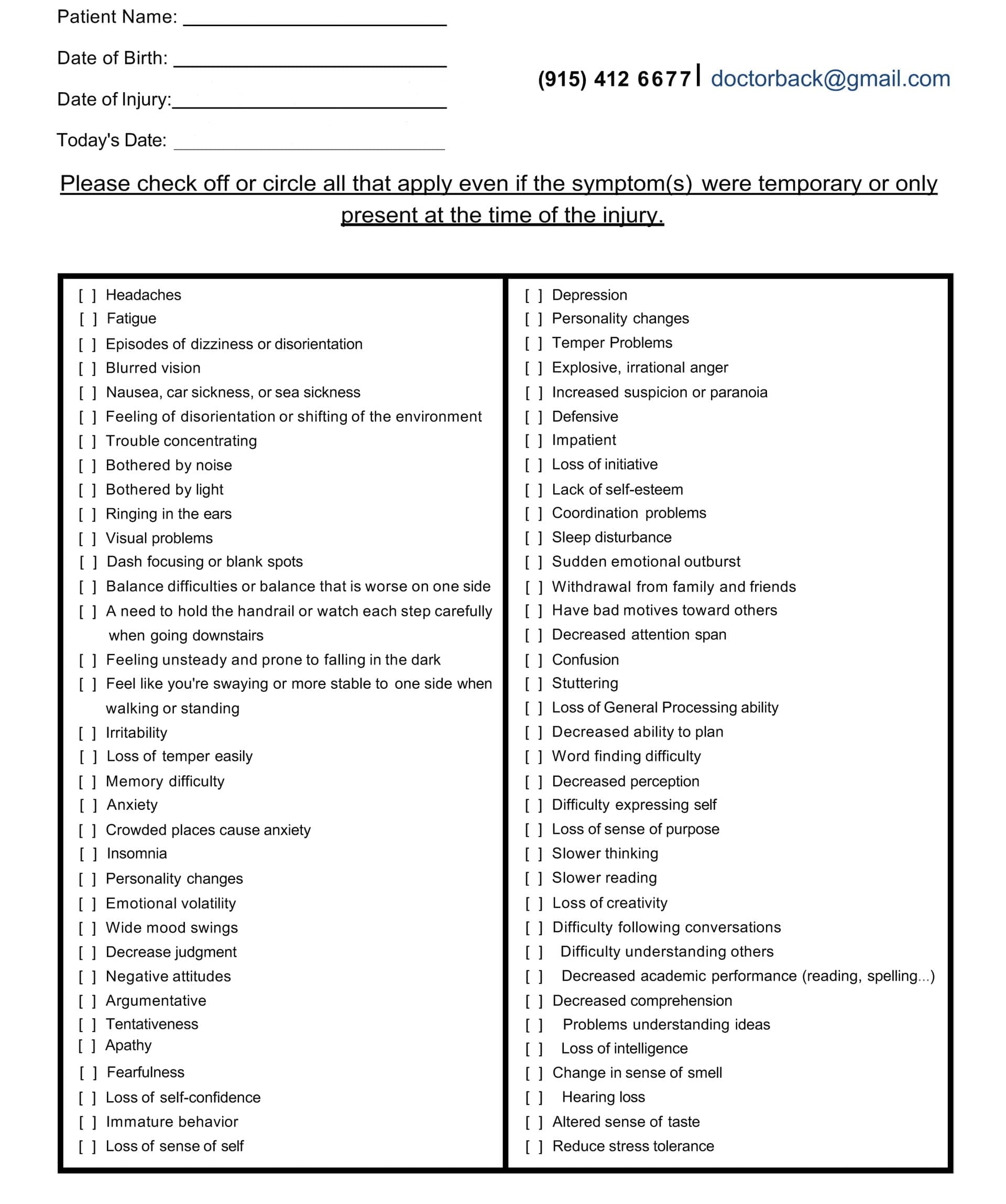
Symptom Questionnaire:
 When Muscles Shrink and Joints Lock: Contractures
Lie in bed for weeks, and your heels pull toward your knees. That’s a contracture. After a TBI, weak muscles and spasticity (sudden, tight jerks) can accelerate this process. Ankles, knees, elbows, and wrists can freeze in bent positions (Physiopedia, n.d.).
Contractures hurt. They also steal flexibility. A stiff ankle means you can’t push off the ground. A locked elbow stops you from hugging your kids.
Why the Neck and Spine Matter So Much
Most TBIs come with whiplash. The head snaps, the neck bones (cervical vertebrae) jolt out of line. Misaligned vertebrae pinch nerves that control arms, legs, and balance. Blood and brain fluid slow down. Result? More stiffness, more headaches, more wobbles (Cognitive FX, n.d.).
Real Stories, Real Struggles
Dr. Alexander Jimenez, a chiropractor and nurse practitioner in El Paso, sees this every week. One patient, a 28-year-old teacher, couldn’t lift her coffee cup six weeks after a rear-end crash. Gentle neck adjustments, soft-tissue massage, and balance drills on a wobble board restored her grip in just eight visits (Jimenez, 2024).
How Chiropractic and Integrative Care Unlock the Body
Chiropractors don’t just crack backs. They use a full toolbox:
- Spinal Adjustments – Tiny adjustments put vertebrae back in line, allowing nerve signals to flow freely. Better signals = smoother steps (Northwest Florida Physicians Group, n.d.).
- Soft-Tissue Therapy – Hands-on massage helps melt tight knots in neck and shoulder muscles that pull the posture forward (Artisan Chiropractic Clinic, n.d.).
- Targeted Exercises – Standing on foam, catching a ball, walking heel-to-toe—these retrain the brain and body to work as a team (Crumley House, n.d.).
- Posture Reset – Slumped shoulders strain the neck. Simple cues—“ears over shoulders, shoulders over hips”—cut headache pain by 50 % in many patients (Pinnacle Health Chiropractic, n.d.).
Blood Flow and Brain Juice
Adjustments open tiny gates in the spine. More blood rushes to the brain. Cerebrospinal fluid (the clear liquid cushion) circulates better. Patients report clearer thinking and less dizziness within days (Impact Medical Group, 2024).
Step-by-Step Recovery Plan Anyone Can Start
Week 1–2: Gentle Wins
- Lie on your back; a chiropractor glides your neck side to side.
- Use ice for pain and heat for stiffness.
- Stand and shift weight side to side—30 seconds, three times a day.
Week 3–6: Build the Base
- Seated marches: lift knees like climbing stairs.
- Wall push-ups to wake up shoulder muscles.
- Soft neck rolls to loosen whiplash scars.
Week 7+: Real-Life Drills
- Walk on grass or carpet—uneven ground reboots balance sensors.
- Carry a laundry basket to retrain arm swing.
- Single-leg stands while brushing teeth.
Red Flags: When to Call the Doctor Today
- A sudden worsening headache
- One pupil is bigger than the other
- Can’t wake up
- New arm or leg weakness
These can signal bleeding or swelling. Get to the ER (Brain Injury Association of America, n.d.-a).
Kids, Athletes, Seniors—Everyone Can Benefit
A high school linebacker with a concussion regains sprint speed. A grandmother who fell in the shower returns to bingo. Chiropractic care scales to every age (Sam’s Chiropractic, n.d.).
Science Backs the Gentle Touch
A 2022 review of 47 studies found that spinal adjustments, combined with exercise, reduced dizziness 68% more than medication alone (Gyer et al., 2022). Another study showed soft-tissue work reduced neck pain in 9 out of 10 TBI patients (PMC, 2022).
Your Next Move—Literal and Figurative
Book a chiropractor who works with brain injuries. Ask:
- “Do you use low-force tools safe for TBI?”
- “Can you team up with my physical therapist?”
- “Will you track my walking speed each month?”
Bring a buddy to the first visit. They’ll spot wobbles you miss.
Hope in Every Step
Six months ago, Mark couldn’t climb three porch steps without his wife’s arm. Today he coaches his son’s tee-ball team. His secret? Twice-weekly adjustments, daily heel raises, and refusing to sit longer than 20 minutes.
You can write the same story. One gentle adjustment, one wobble-board minute, one proud step at a time.
References
Artisan Chiropractic Clinic. (n.d.). Relieve accident trauma with chiropractic adjustment. https://www.artisanchiroclinic.com/relieve-accident-trauma-with-chiropractic-adjustment-a-natural-solution-to-pain-management/
Brain Injury Association of America. (n.d.-a). Physical therapy and brain injury. https://biausa.org/public-affairs/media/physical-therapy-and-brain-injury
Brain Injury Association of America. (n.d.-b). Slight changes in walking and balance after traumatic brain injury. https://biausa.org/professionals/research/tbi-model-systems/slight-changes-in-walking-and-balance-after-traumatic-brain-injury
Brain Injury Canada. (n.d.). Mobility. https://braininjurycanada.ca/en/effects-brain-injury/physical/mobility/
Cognitive FX. (n.d.). TBI physical therapy. https://www.cognitivefxusa.com/blog/tbi-physical-therapy
Crumley House. (n.d.). Physical training after TBI. https://crumleyhouse.com/blog_physical_training/
Gyer, G., et al. (2022). Spinal manipulative therapy for post-concussion syndrome. PMC, 9493170. https://pmc.ncbi.nlm.nih.gov/articles/PMC9493170/
Headway. (n.d.). Physical effects of brain injury. https://www.headway.org.uk/about-brain-injury/individuals/effects-of-brain-injury/physical-effects-of-brain-injury/
Impact Medical Group. (2024). Can chiropractic care help with mild traumatic brain injuries? https://www.impactmedicalgroup.com/2024/06/26/can-chiropractic-care-help-with-mild-traumatic-brain-injuries/
Jimenez, A. (2024). Personal clinical observations. https://dralexjimenez.com/
Model Systems Knowledge Translation Center. (n.d.). Understanding TBI: Part 2. https://msktc.org/tbi/factsheets/understanding-tbi-part-2-brain-injury-impact-individuals-functioning
Northwest Florida Physicians Group. (n.d.). Using chiropractic care to treat traumatic brain injuries. https://northwestfloridaphysiciansgroup.com/using-chiropractic-care-to-treat-traumatic-brain-injuries/
Physiopedia. (n.d.). Contracture management for traumatic brain injury. https://www.physio-pedia.com/Contracture_Management_for_Traumatic_Brain_Injury
Pinnacle Health Chiropractic. (n.d.). Six ways chiropractic care supports healing after TBI. https://www.pinnaclehealthchiro.com/blog/six-ways-chiropractic-care-supports-healing-after-tbi
Sam’s Chiropractic. (n.d.). Why chiropractic support improves recovery from auto injuries. https://samschiropractic.com/why-chiropractic-support-improves-recovery-from-auto-injuries/



 Again, We Welcome You.
Comments are closed.