


For individuals who want to eat healthier, can selection and moderation make mayonnaise a delicious and nutritious addition to a low-carbohydrate diet?
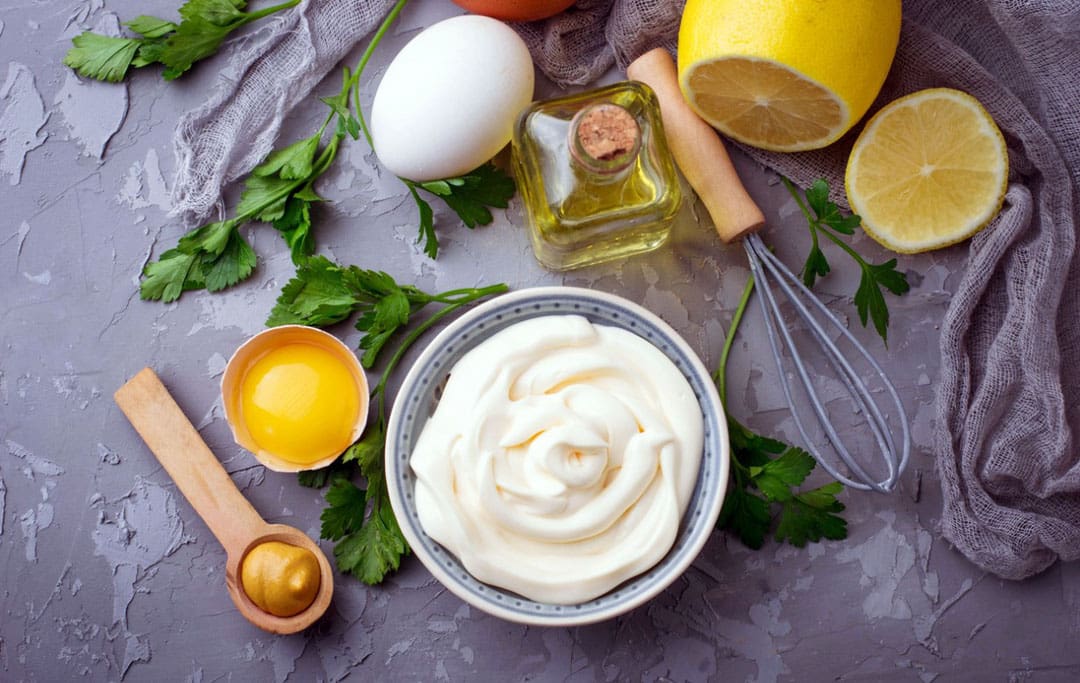
Table of Contents
Mayonnaise Nutrition
Mayonnaise is used in various recipes, including sandwiches, tuna salad, deviled eggs, and tartar sauce. It is often considered unhealthy, as it is mostly fat and, as a result, calorie-dense. Calories and fat can quickly add up when not paying attention to portion sizes.
What Is It?
- It is a blend of different ingredients.
- It combines oil, egg yolk, an acidic liquid (lemon juice or vinegar), and mustard.
- The ingredients become a thick, creamy, permanent emulsion when blended slowly.
- The key is in the emulsion, combining two liquids that would otherwise not naturally come together, which turns the liquid oil into a solid.
The Science
- Emulsification happens when an emulsifier – the egg yolk – binds the water-loving/hydrophilic and oil-loving/lipophilic components.
- The emulsifier binds the lemon juice or vinegar with the oil and does not allow separation, producing a stable emulsion. (Viktoria Olsson et al., 2018)
- In homemade mayonnaise, the emulsifiers are mainly the lecithin from the egg yolk and a similar ingredient in mustard.
- Commercial mayonnaise brands often use other types of emulsifiers and stabilizers.
Health
- It contains health-promoting properties, such as vitamin E, which improves heart health, and vitamin K, which is important for blood clotting. (USDA, FoodData Central, 2018)
- It can also be made with healthy fats like omega-3 fatty acids, which maintain brain, heart, and skin health.
- It is mostly an oil and high-fat calorie-dense condiment. (H R Mozafari et al., 2017)
- However, it is mostly unsaturated fat, which is a healthier fat.
- To maintain nutrition goals in mind when selecting mayonnaise.
- For individuals on a low-fat or low-calorie diet, portion control is important.
Oil
- Almost any edible oil can be used to make mayonnaise, making the oil the biggest factor in the recipe’s healthfulness.
- Most commercial brands are made with soy oil, which some nutrition experts believe can be problematic because of the high levels of omega-6 fats.
- Canola oil has a lower omega-6 content than soy oil.
- Individuals who make the mayonnaise can use any oil, including olive or avocado oil.
Bacteria
- The concern about bacteria comes from the fact that homemade mayonnaise is usually made with raw egg yolks.
- Commercial mayonnaise is made with pasteurized eggs and is produced in a way that keeps it safe.
- The acids, vinegar, or lemon juice can help keep some bacteria from contaminating the mayonnaise.
- However, a study found that homemade mayonnaise may still contain salmonella bacteria despite the acidic compounds. (Junli Zhu et al., 2012)
- Because of this, some prefer to pasteurize an egg in 140°F water for 3 minutes before making the mayonnaise.
- Regardless of the type of mayonnaise, food safety guidelines should always be followed (United States Department of Agriculture, 2024).
- Mayonnaise-based dishes should not be left outside refrigeration for more than two hours.
- Opened commercial mayonnaise should be stored in the refrigerator after opening and discarded after two months.
Reduced-Fat Mayonnaise
- Many nutritionists recommend reduced-fat mayonnaise for individuals on a low-calorie, low-fat, or exchange diet. (Institute of Medicine (US) Committee on Dietary Guidelines Implementation, 1991)
- While reduced-fat mayonnaise has fewer calories and less fat than regular mayonnaise, the fat is often replaced with starches or sugar to improve texture and flavor.
- For individuals watching carbohydrates or sugar in their diet, check the nutrition label and ingredients before deciding on the right mayonnaise.
Body In Balance: Chiropractic, Fitness, and Nutrition
References
Olsson, V., Håkansson, A., Purhagen, J., & Wendin, K. (2018). The Effect of Emulsion Intensity on Selected Sensory and Instrumental Texture Properties of Full-Fat Mayonnaise. Foods (Basel, Switzerland), 7(1), 9. https://doi.org/10.3390/foods7010009
USDA, FoodData Central. (2018). Mayonnaise dressing, no cholesterol. Retrieved from https://fdc.nal.usda.gov/fdc-app.html#/food-details/167736/nutrients
Mozafari, H. R., Hosseini, E., Hojjatoleslamy, M., Mohebbi, G. H., & Jannati, N. (2017). Optimization low-fat and low cholesterol mayonnaise production by central composite design. Journal of food science and technology, 54(3), 591–600. https://doi.org/10.1007/s13197-016-2436-0
Zhu, J., Li, J., & Chen, J. (2012). Survival of Salmonella in home-style mayonnaise and acid solutions as affected by acidulant type and preservatives. Journal of food protection, 75(3), 465–471. https://doi.org/10.4315/0362-028X.JFP-11-373
United States Department of Agriculture. Food Safety and Inspection Service. (2024). Keep Food Safe! Food Safety Basics. Retrieved from https://www.fsis.usda.gov/food-safety/safe-food-handling-and-preparation/food-safety-basics/steps-keep-food-safe
Institute of Medicine (U.S.). Committee on Dietary Guidelines Implementation., Thomas, P. R., Henry J. Kaiser Family Foundation., & National Cancer Institute (U.S.). (1991). Improving America’s diet and health : from recommendations to action : a report of the Committee on Dietary Guidelines Implementation, Food and Nutrition Board, Institute of Medicine. National Academy Press. http://books.nap.edu/books/0309041392/html/index.html
https://www.ncbi.nlm.nih.gov/books/NBK235261/



 Again, We Welcome You.
Comments are closed.